Correct posture for running to lose weight
Correct running posture 1. Head and shoulders
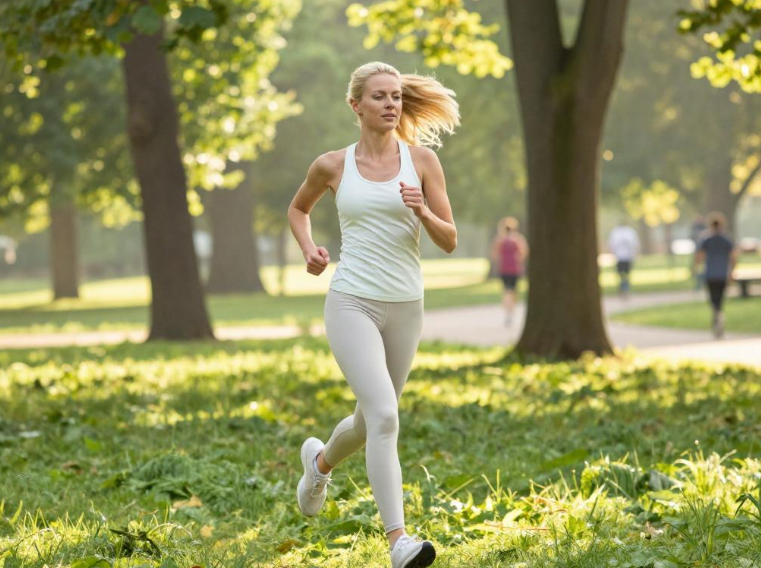
Essentials of running movements - Keep your head and shoulders stable. Your head should be facing forward. Unless the road is uneven, do not lean forward and keep your eyes focused forward. Relax your shoulders appropriately and avoid holding your chest.
Power Stretch – Shrug. Relax your shoulders and sag, then shrug as high as possible, stay for a moment, then restore and repeat.
Correct running posture 2. Arms and hands
Essentials of running movements - the arm swing should be a forward and backward movement with the shoulder as the axis, and the range of left and right movements should not exceed the midline of the body. Fingers, wrists, and arms should be relaxed, and the elbow joint angle should be approximately 90 degrees.
Power stretching – raise your elbows and swing your arms. The two arms are in a ready starting position in front of one another. The elbow joint of the back swing arm is raised as high as possible, and then the forward swing is relaxed. As the movement speeds up, lift it higher and higher.
Correct running posture 3. Trunk and hip
Essentials of running action - keep upright from neck to abdomen, rather than leaning forward (unless accelerating or going uphill) or leaning back. This is beneficial to breathing, maintaining balance and stride length. Do not rock your torso from side to side or rise and fall too much. Actively push your hips when swinging your legs forward, and pay attention to the rotation and relaxation of your hips when running.
Power Stretch – Lunge Leg Press. Stand with your legs front and back, shoulder-width apart, and slowly press down the center of your body until your muscles are tense, and then relax back to normal. The torso remains upright at all times.
Correct running posture 4. Waist
Essentials of running movements - keep your waist naturally upright and not too straight. Slightly tense the muscles, maintain the trunk posture, and pay attention to cushioning the impact of the foot landing.
Power stretching - forward flexion and extension. Stand naturally with your feet shoulder-width apart. Slowly bend the trunk forward until the hands drop to the toes, hold for a while, and then recover.
Correct running posture 5. Thighs and knees
Essentials of running action - swing your thighs and knees forward, rather than lifting them up. Any lateral movement of the legs is unnecessary and can easily cause knee joint injuries, so the thighs must be swung forward.
Power stretch - forward arch. Stand with your feet hip-width apart. Place your hands behind your head. Bend forward from the hip joint. Keep your back straight until you feel tension in your biceps femoris.
Correct running posture 6. Calf and Achilles tendon
Essentials of running motion - Your feet should land about one foot in front of your body, close to the midline. The calf should not be stretched too far to avoid strain on the Achilles tendon due to excessive force. At the same time, you should pay attention to the cushioning of the calf muscles and Achilles tendon when landing. When landing, the calf should actively push the ground backward to make the body move forward actively. In addition, the calf swing direction should be in the correct direction, and the feet should be pointed forward as much as possible, and should not turn eversion or backward, otherwise the knee and ankle joints will be easily injured. You can check your footprints for reference while running on the beach.
Power stretching – wall heel raises. Stand about 1 meter away facing the wall, with your arms stretched forward and shoulder width apart, and your hands supporting the wall. Raise your heels and then lower them, feeling tension in your calves and Achilles tendons.
Correct running posture 7. Heels and toes
Essentials of running movements - If the stride is too long and the calf extends too far forward, the heel will hit the ground, resulting in a braking reaction force, which will cause great damage to bones and joints. When landing correctly, land on the middle of your foot and allow the impact to be quickly distributed throughout the ball of your foot.
Power stretching - seated ankle extension. Kneel on the ground, with your buttocks close to your heels, keeping your upper body upright. Slowly put downward pressure on the ankle joint until the toe extensor muscles and forefoot feel enough tension. Then lift your hips and repeat. The movement should be rhythmic and slow.
The principle of weight loss is mainly to increase energy consumption and reduce energy intake. Running can effectively increase energy consumption and thereby reduce weight. However, running to lose weight requires a certain amount of exercise to achieve the goal of losing excess fat. Generally speaking, if you want to burn 1 kilogram of fat, you need to run about 10 kilometers.
Disclaimer:
1. This article is sourced from the Internet. All content represents the author's personal views only and does not reflect the stance of this website. The author shall be solely responsible for the content.
2. Part of the content on this website is compiled from the Internet. This website shall not be liable for any civil disputes, administrative penalties, or other losses arising from improper reprinting or citation.
3. If there is any infringing content or inappropriate material, please contact us to remove it immediately. Contact us at: